Planning To Build Your Dream Luxury Home?
Contact UsPlanning To Build Your Dream Luxury Home?
Contact Us
Buying land is often the first real decision in a custom home project, and it can also be the most confusing one. A parcel that looks generous on a map might not leave room for the house you actually want once setbacks, driveways, and septic fields get factored in. A smaller lot in the right zoning district, on the other hand, can work perfectly well. Getting this number right before you buy saves money, time, and a fair amount of frustration once the design process starts.
For anyone trying to determine “how much land is required to build a house,” it is important to look beyond the size of the parcel itself. Local zoning requirements, building setbacks, site conditions, driveway access, and other property restrictions can all affect how much usable space you actually have for your home.
A 3-to-1 or 5-to-1 ratio can be used as a rough planning estimate, but it is not an Austin zoning requirement or a universal industry standard. For example, multiplying a 3,000-square-foot footprint by three produces a 9,000-square-foot planning estimate. The actual lot needed may be smaller or larger depending on setbacks, lot dimensions, coverage limits, utilities, site conditions, and the home’s design.
Land requirements for building a house grow further when the site includes a pool, a detached garage, or a sizable outdoor kitchen. The table below shows how the ratio scales across a few common home sizes.
| Home Footprint (sq ft) | Land-to-Building Ratio | Recommended Lot Size | Approx. Acres |
| 1,500 | 3:1 to 5:1 | 4,500 to 7,500 sq ft | 0.10 to 0.17 |
| 2,500 | 3:1 to 5:1 | 7,500 to 12,500 sq ft | 0.17 to 0.29 |
| 3,500 | 3:1 to 5:1 | 10,500 to 17,500 sq ft | 0.24 to 0.40 |
| 5,000 | 3:1 to 5:1 | 15,000 to 25,000 sq ft | 0.34 to 0.57 |
Zoning sets the floor under every land purchase in Austin, and the rules vary a great deal by district. The city’s Land Development Code groups single-family property into several base zones, each with its own minimum lot size, setback distance, and height limit. They can affect your lot size, building coverage, impervious cover, allowable dwelling units, floor area, and whether your property qualifies for special small-lot provisions. Checking the current zoning map before you buy is not optional. It is the only way to know what a given parcel will actually allow.
SF-1 is Austin’s Large Lot single-family residence district and carries the largest minimum lot requirement among the three single-family classifications covered here. Lots must have at least 10,000 square feet and 60 feet of width, while building coverage is limited to 35% and impervious cover to 40%. These tighter coverage limits leave more of the lot open compared with SF-2 and SF-3.
SF-2, or Standard Lot, requires a minimum 5,750-square-foot lot with 50 feet of width. The district permits up to three dwelling units, with a maximum height of 35 feet, building coverage of 40%, and impervious cover of 45%. Its lot and coverage standards provide more flexibility than SF-1 while maintaining a defined residential development framework.
SF-3, known as the Family Residence district, also requires a minimum 5,750-square-foot lot and 50 feet of width. It allows up to three dwelling units, with a maximum height of 35 feet, 40% building coverage, and 45% impervious cover. SF-3 was historically associated with moderate-density single-family and duplex development, although current HOME provisions allow up to three dwelling units on SF-1, SF-2, and SF-3 lots.
Austin’s MF-1 through MF-6 districts cover multifamily development and differ from the single-family districts in how density is regulated. These multifamily districts do not set a units-per-acre limit, giving projects a different framework for determining residential capacity. The appropriate multifamily designation and other applicable regulations still need to be considered when evaluating what can be developed on a particular property.
Floor-to-Area Ratio (FAR) and Subchapter F determine how much countable floor area can be developed on certain residential lots. On a standard single-dwelling lot of 5,750 square feet or larger, Austin allows the greater of 0.40 times the lot size or 2,300 square feet of countable floor area. For example, a 7,000-square-foot lot allows up to 2,800 square feet under that calculation. Subchapter F can impose additional requirements, so the lot’s location and proposed development matter.
Austin’s HOME provisions changed the residential development framework by allowing up to three dwelling units on SF-1, SF-2, and SF-3 lots. This means homeowners evaluating a property should consider more than the traditional single-family use associated with its zoning designation. The number of units you plan to build can also affect which development standards apply.
Austin provides specific provisions for small lots, which are at least 1,800 square feet but less than 5,750 square feet on SF-3 or more restrictive zoning. Impervious cover also plays an important role in determining how much of a lot can be occupied by surfaces such as buildings and other covered or paved areas. Most Austin single-family lots allow 45% impervious cover, while SF-1 has a lower 40% limit.
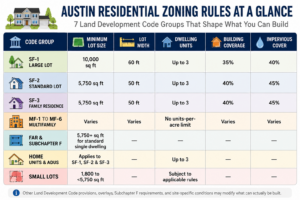
Infographic Source: Austin residential zoning districts
Public water and sewer access can shrink the amount of land you need, while a reliance on a well and septic system usually increases it. Properties without public sewer may require additional land for a septic system, including the treatment and disposal area and required setbacks. The amount of land needed depends on local regulations, soil conditions, system design, and the characteristics of the proposed home. Land requirements for a rural or semi-rural Austin-area parcel can depend heavily on site and soil conditions. Soil evaluations, wastewater regulations, and septic-system design requirements help determine how wastewater can be treated and dispersed on the property. Buyers should also confirm road access, drainage patterns, and whether any part of the property sits inside a floodplain before finalizing a purchase.
A land evaluation should happen before signing a contract, not after. Reviewing zoning, setbacks, and utility access for a property in advance prevents costly surprises once design work begins. When it’s time to turn your lot into a home that fits your vision, work with the custom home builders in Austin, TX. Our team helps homeowners plan thoughtfully around the property, design, and construction details to create a custom home built specifically for the lot.
Neighborhood context matters as much as zoning code. Pemberton and central Austin lots tend to run smaller and more urban, often under a third of an acre, with homes designed vertically to make the most of limited square footage. Westlake and Barton Creek properties frequently span a full acre or more, with hill country topography, mature trees, and views that shape the buildable footprint in ways a flat urban lot never would. The best land size for a custom home depends on which of these settings fits the lifestyle a buyer actually wants, not on a single number that applies everywhere in the city.
Buyers do not need an engineering background to reach a reasonable land estimate before making an offer. A short framework covers most of what matters:
Using a 3-to-1 planning ratio as a rough estimate, a 3,000-square-foot home footprint points to roughly 9,000 square feet of lot area at minimum. Many custom home buyers choose a larger lot than this baseline to make room for outdoor living space, landscaping, and privacy from neighboring homes.
Yes. The HOME Initiative reduced minimum lot sizes in several single-family zoning districts, including SF-3, where the minimum dropped from 5,750 square feet to as little as 1,800 square feet in many cases. Buyers should check current zoning before assuming older minimums still apply.
A septic system requires appropriately designed treatment and disposal components that meet applicable regulations. Soil conditions, site characteristics, wastewater volume, and system-design requirements can all affect the amount of land needed.
Yes, and many custom homes in central Austin neighborhoods sit on lots well under an acre. Urban infill lots often work well for vertically designed homes, provided the design respects the zoning district’s setback and height rules.
Confirming the zoning district and its minimum lot size, setback rules, and utility access is the first practical step. This information determines what can actually be built on a given property before any design work begins.
Land size is not a fixed number that applies to every custom home project. It shifts with zoning rules, utility access, neighborhood character, and the size of the home a buyer has in mind. A land-to-building ratio offers a reasonable starting point, and checking Austin’s current zoning designations narrows that estimate considerably. Buyers who confirm these details before purchasing a lot save themselves from costly redesigns and delays once construction begins.
We have spent more than two decades building and remodeling homes. We offer plans for fixed and itemized budgets that remove the guesswork before construction ever starts. If you need expert help with kitchen remodeling in Austin, TX, request a free design consultation with our team.